
Thoughts on why Spec Work is Bad and Why You Shouldn’t Do It

February 16, 2011 - 22 CommentsWritten by

Speculative, or ‘Spec’, work is in hot debate at the moment in the design industry. Design contest websites in particular have created a furore of debate over freelancers working initially for nothing, instead hoping that a client likes their work enough to want to pay for it.

What is Spec Work?

Speculative work is where you agree a price, but the client pays in full upon acceptance of the work. In other words it is where you submit full completed work before you have taken any form of payment, or signed a binding contract.

Really? Spec Work is widely condemned
Really? Spec Work is widely condemned.

My Story

Let us be clear that spec work is not just about design contest websites. Back when I worked freelance after graduating from University, I began plying for work on community websites. The kind of people that got back to me would list their demands. I would inform them on the likely cost and then I would begin working. Naturally, it just so flowed that I would then show them how I was getting on.
This was a big mistake because inevitably they would want changes, or worse, want me to start again. And of course, when this happened, nothing was said about the cost.
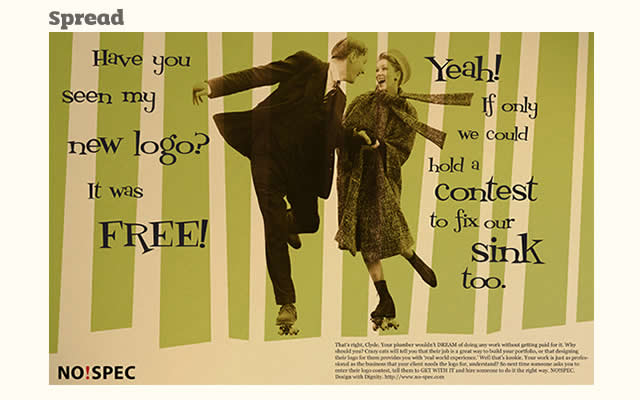
NO!SPEC’s campaign to build awareness of the damaging effects of spec work is gaining momentum

Unfortunately, design work suffers because the quality of the work is much down to interpretation. Everybody has their own opinions on whether a logo, website, etc is good or not. Whereas when you call in a plumber, you don’t question their techniques and the end result is irrelevant – it either works or it doesn’t, there is little or no degree of interpretation.
So of course, what kept happening to me is I would spend dozens of hours on work only to find myself unpaid. I even built a fully functioning e-commerce site for a client who decided she didn’t like it after a whole month of work.

Why is Spec work bad?

Apart from the point above, that you may find yourself unpaid, there are other issues that bring a negative feeling to spec work.

Designers

• Competition.
With design contest websites you are competing with hundreds of other designers. So you could spend a lot of time creating design work for absolutely nothing.

• Even if you do win, the fees are small.
99designs pays as little as $100 for a logo. That’s if you win. This also has another side effect in that it creates unrealistic expectations of how much design work costs, which could have a negative impact on all of us, not just those of us that use contest sites.

• Design contest websites claim they benefit designers by adding to your portfolio and giving you recognition.
But are you willing to work, more than likely for nothing, for the sake of recognition? Even so, it’s debatable if contest work will actually help you.

• Your quality of work will suffer.
Naturally, we don’t care so much about work if we’re not getting paid for it. Invariably, if you submit entries to a contest site they will more than likely not be as good as work you do when you have been paid a fee up front.
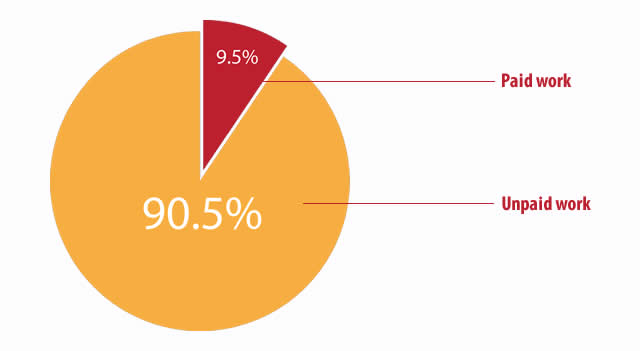
The grim reality of spec work is it leaves the majority of designers unpaid
The grim reality of spec work is it leaves the majority of designers unpaid. Image source: TheLogoFactory.com.

Clients

From a clients point of view, it would be extremely frustrating if we paid £500 for a logo yet the end result was nothing close to what we wanted and we ended up not even using it. Imagine having to repeat this process several times until you got the logo you wanted, it could end up costing thousands. However, even from a client’s point of view, speculative work should be avoided and the results may not match the temptations of the low costs.

• Low quality work.
Because there is little chance of designers winning, most who submit work spend little time on it and it is usually of a low quality, clip art is prevalent. If you are serious about the brand identity of your company, a design agency or professional individual designer is the sensible choice.

• Anonymity of designers.
Would you open your front door to a decorator in a balaclava? Allowing someone who you do not know and have little or no idea about where they are from or who they are to brand your company or build your website is foolishness, for the same reasons you wouldn’t let someone else you don’t know to tamper with any other aspect of your business.

• Design contests essentially promote free labour.
You wouldn’t call over 10 plumbers to fix your toilet and only pay one of them – so why should this be any different? Simple – it shouldn’t.

• Plagiarism.
Plagiarism is nothing short of rife on design contest sites. You may think you are getting an original logo, but where did that clip art come from? Is the font licensed? The logo a client gets may not be legitimate, it may even be illegal.

What should I do instead?

First of all, every freelancer should have a rough pricing structure. My advice would be if freelance is really the way you want to go, invest some time working out how much you feel you should be paid for work. Your pricing structure doesn’t need to be rigid, in fact it should be flexible, but it is essential you know your worth before you do any work. Remember, don’t undervalue yourself, you are charging people not just for your time, but your expertise. Don’t forget to make it clear what happens when the client asks for revisions.

Secondly, get everything in writing and agreed and signed for before you commence a project. Inform your prospective client of all the costs, and explain them. You should also explain to the client that if you are working by the hour, actual costs may vary. If they want to spend a fixed amount, agree a fixed fee for a fixed number of hours of your time. If you have to go over these hours, charge for them but liaise with the client first. The best thing to do is to get everything written in a legally binding contract which the client signs. They are then obligated to pay you, providing you complete the work.

If you are a client and you don’t want to be a position whereby you have paid for unsatisfactory work, the best practice is to go to a reputable design company or freelancer. Be as helpful to the designer as possible, make it clear what the ethos of your business is and try and be clear in your demands – don’t contradict yourself, it’s very frustrating when clients ask for a minimal design but then ask for a floral background.

If you are a designer just starting out, you may have to find yourself charging smaller fees for your work and plying for jobs on community boards such as Gumtree and Craigslist. This isn’t necessarily bad but there are other ways. I have found being a member of Concept Feedback highly beneficial – at first the work I submitted was just for fun but as I became a member of the community I actually was approached for work by people who had seen my designs on the site. Additionally, the feedback I got has improved me as a designer hugely. Be proactive, make business cards and flyers and promote yourself locally.
And lastly, one key tip which I think is worth mentioning is the relationship between client and designer is usually several times better when you know them in person. Don’t be afraid as a designer to meet your client. If you have to travel for an hour on a train just for a coffee – so be it. It will also portray you in a good light because it shows you care about the work.

If you have anything to add about spec work or would like to share your own experiences or thoughts, I would love to hear from you.

Further reading and resources:
Billing Best Practices for Freelance Web Designers →
Ethics and Professional Practice → via gdc.com
Spec work for Web Developers → via rachelandrew.co.uk
No More Spec Shooting! →
Concept Feedback →

About the Author: (1 Articles)

Michael is a web designer/developer working in the aviation industry. He has been working as a web developer for nearly 2 years since graduating with a degree in product design from University of Sussex in England.

Comments and Reactions

  • Saifur

    Pretty realistic experiences and thoughts put to words.

  • Alex

    You’re absolutely right! Spec work sucks bigtime!

    And i must say that i’m beginning to worry about the overall quality of online designwork ( over here in the netherlands )..

    There are just SO many awefull websites, bad logo’s etc.

    But, it’s not just those cruel bad socalled ‘designers’ who make that remarkeble work a possibilty, it’s also because of the clients.

    There are 2 types of clients who make sure the web is polluted.

    1. The type of client who let them to be fooled by so called big agencies who happily charge 15.000 euro’s for crap! and i mean realy CRAP. Using a ugly 12 dollar template with some crapy cms and the client is REALY amazed by some scrolldown menu thinking it’s state of the art technique they’re paying for.

    2. The client who wants to sit on the front row for a nickle. And believe you me; there are a LOT of clients like that. With a shitload of ‘freelance matching sites’ over here where the ratio clients/freelancer is about 2000/300, they want the whole wide world for a couple of bucks ( euro’s in my case ). And the worst thing is; within 5 freakin minutes they have like 50 potential ‘freelancers’ who are willing to take the job for even less!

    But i think the best you can do is just to ignore those people and not be afraid to actualy charge reasonable money for GOOD quality work!

    Sooooo, glad i could get that out of my mind :)

  • Linus

    I never comment – but I’ve been freelancing for more than a decade and all this is so true I need to leave one just this once :).
    Your tale of costumers wanting to change things, dibble with color for months and keep on changing till world-ends is not unique. Hold on to your hat, this will be ugly. Every costumer does this. No matter how well cultivated and educated the project manger is (from the clients side) there will always be someone in the organization that things he/she/it is an artist in disguise ( = don’t know how, but can “see” when its perfect).
    There is only one way to deal with this – and trust me I’ve bumped my head so many times its a wonder I’m still in this biz:
    Hourly paid. Say something like this to the prospect buyer:
    “Ok, I’ve been doing this for a while now and no matter how much time we believe this will take – it might take some more. So let’s do like this, for price X you get a first sketch and two revisions of the design – not two new designs mind you, two revisions with fixes and minor changes.
    Would you change your mind somewhere in that period and want to go another route – we do it again – same money one more time and two revisions included. When you have decide and if you realize that you want more changes after the two revisions – I take an hourly rate of Y. – does that sound good to you?”

    If they refuse say OK, thanks and goodbye.

    One more thing you should get in there is deadline – here is the kicker – a deadline for the client. Say “this should span over the course of X time (I go for two weeks on smaller and no more than up to a month – if more is required make it in to smaller projects) and after that I fall back on the hourly rate of Y until its done.”

    The amount of clowns out there looking for a deal is enormous. Don’t bother with them – They are part of the negative side of the 80-20 rule (80% no-good 20% very good).

    It took me 10 years of hating (even if only part time – 20% love) myself for letting shit hit the fan over and over again so if you’re any smart at all – take em to heart.

    The competitions are jokes as you so very well state Michael – spend your time with better things. If you need practice: go crazy with something awesome – not some semi-shitty hosting service that goes for the other (more voted on) logotype.

    Wow I’m spilling it out here – last topic of this bottled-up-for-a-decade rant:

    It’s not only here we get nagged for “help”.
    Any designer here asked for help on “friends”projects? Ok, and girlfriends/boyfriends business/projects? – friends help out for free right? So how do you deal with the flood of “I loved your Y illustration in magazine ZXY – and I have a small XY business and was just…”?
    Well its very very f*cking hard.

    But you say no.

    Remember that your time on this earth is limited – and how much of that should you spend on the phone with your wife’s cousin talking about Verdana vs Arial (late at night – Sunday)?
    Absolutely zero.

    We as a profession are in high demand – nice graphics everywhere. But the inflation of the Internet and the fact that we do not mix our own colors (but you only need a computer right?) nor walk with sticks and high hats – makes people think its “Fun!” to help out with whatever-design-they-need-slash-want.

    If you help a friend moving – at least you get pizza and a beer. Require the same when helping out a friend with whatever is related to your profession. But pizza everyday gets you darn fat so take it in a better currency. Money springs to mind.

    But your girlfriend/boyfriend gets mad at you for not taking the time to help her cousin learn illustrator over the phone (something you have spent thousands of hours perfecting if combined with the rest of the applications needed) and just get that thing right in that logo for auntie?
    Sit her/him (girlfriend/boyfriend) down and say:

    “Honey, I know you want me to earn money – and have time for you and the dog/kids/friends/whatever-applies and in my profession I get requests everyday to make amazing things, but for free “just this ones” and that is the nature of my business and the era we live in. I can’t change that but what I can do is simply say “No” and that means that they will either take the time to learn how to do it themselves and pay with the currency “time” or they will have to find someone else to beg for a freebie and if that person says “No” too – they might actually appreciate that this is a job – And pay someone to do it.”

    your better half might still think you’re an ass (donkey) then give your best smile and say
    “but hey! Tell’em I’ll help’em move if there is Pizza and beer!”

    /end-of-rant-start-charging-for-2022-years-rant-now ../Linus

  • http://brandmooreart.daportfolio.com Brandon Moore

    while i agree for the most part about the article, i will say there are some good things about spec sites that young designers or students can take advantage of that the article never comes close to addressing.

    not every contest pays out $100. the majority logo contest pay is somewhere around $250 – 300 (some in the 4 digits as well). very low yes, but when i was a student i took a chance on a couple of sites and ended up winning 2 contest. the $200+ plus i won from both were HUGE to me at the time as i was riding the city bus to school everyday, and had about $2 for lunch most days. not to mention, i did more work for those clients afterwards, and 1 is still a common client, which ive also received many recommendations from. its all about contacts right?

    secondly, the experience i gained from the sites was quite helpful. it made me work faster, the competition made my work better, and i got some real world client interaction, with a real brief. not just a student project.

  • http://speiderschneider.blogspot.com Speider Schneider

    There can never be too many articles discussing how spec work is bad for the industry. Unfortunately, there will always be those who rush to enter these contests or not protect their rights with clients by using a contract, so the rest of us can hear, “I never had to sign a contract before!”

    One thing you failed to mention about these contests, is that those who do not win have signed over all rights to their submissions with no consideration or payment at all. The company that runs the contest gains a lifetime of logos for whatever they deem fit.

    Not to spank the young designers who defend the practice of contests and crowdsourcing as “beneficial” to their careers, please understand that you are supporting a practice that deteriorates the industry in which you wish to work and make a living and will eventually limit your earning potential. When it comes to working for free, giving away your rights or speculative work…just say, “NO!” Then, and only then will clients have no choice but to pay for work. That’s why they call it “work” and not “free!” (I have to get up and go to free?).

    What’s next…contests for full time positions? I’ve got bad news for you…some companies are asking candidates for full time positions are asking for “tests” at, you guessed it…speculative terms. See what you did?!

  • http://www.behance.net/scedy Cedrick

    Linus, I think you’ve the best comment I ever read about the Spec Work topic on the web. The best. In all aspects.

    Michael Garner, thank you for this great piece of article !

    Cheers, and no more spec work ! It’s a question of educating the client.

    Thanks a lot.

  • Frustrated Designer

    I am leaving my comment in support of this article mainly because I “am” a victim… yes a “victim” of all of this. I have been in this business over 17 years and this past two years or so, I have noticed an increase in clients who want to just tear design down, use competition websites as a jump off point… “I can get a logo for X dollars” and not understand that bringing that logo to other elements in an incorrect format will potentially harm the rest of the project… too many cooks in the kitchen perhaps? And, what is it with clients complaining about designers just willy nilly out on rip off report? Anyone who doesn’t have their head up their tail should know that design is a highly technical and creative environment. Designers … do NOT work on spec and even though it is tempting, please do NOT do it. Say NO and say NO because if you are going to work for free, work for free for yourself, at least you are honing your own craft and abilities. Everyone has room to improve and re-educate. And, do I dare say if the designers would stop taking such low paying jobs and working on spec, maybe the rest of us would stop getting paid peanuts and clients would “have” to realize they need to PAY. We need to get paid “up front” for our time and effort for ALL design. Because if a client “can” screw us on the back of a deal or NOT pay, they WILL. By the way, this is NOT my two cents… it’s my experience!

  • Michael Gunner

    Fantastic comments guys. Not much more I can add, except I agree with all that you guys say, spec work has the potential to be highly damaging and hopefully we can all pull together to say No.

  • Jimmy

    I double Linus and Frustrated Designer comments.

    I am living this nightmare right now, 2 months developing an e-commerce website that has been worked and reworked around, and still no money on the table.
    There is also another thing to look out for, in my case, working with a middle man/woman who has aprouched you on behalf of the client (in this case the developer who got the job and is a friend of a friend) in need of a front-end developer, the promises of more and hugely paid jobs keep pouring in to keep you on the job until it’s finished.

    In the current economic context it is getting harder and harder to say no, but we HAVE TO!!

  • http://jaybanks.ca Jay B.

    Great article and comments as well. I never thought about the spec work so much. Finally somebody brought a constructive analysis in. I think that after reading this nobody can say many positive arguments in favour of spec. I agree with Cedric, lets educate the client in order to prevent this.

  • Tenley

    I have been very successful with clients by giving them an estimate (after consultation and research) and requiring a 25% deposit up front, another 25% to deliver a completed framework of a site, and the balance after revisions and changes.

    I usually budget time for 2 or 3 rounds of revisions depending on how big the project is. I also tell them up front the hourly rate and that we might exceed the estimate. I let them know asap if we are running over the estimate. I also tell them what they need to do to keep the costs low – provide all materials up front for example, that major redesigns and additions to the scope of the project will cost them more.

    In the proposal I spell out the parts and function of the site we have agreed upon. It took me several years to get my format together, but it is working pretty well. I will turn down a client I think I cannot trust to be reasonable to work with.

    • HD

       Tenley – i would be very interested to see a proposal template for a site based on the terms you stated. I have worked like this as well but it is always helpful to see how others have articulated things and laid down their limitations for a project.

  • http://usabilitysnippets.com angelee

    By the way you guys react about the article, its clear that some clients are naughty and some designers especially the new ones will get their lesson sooner. If I haven’t read this information, I wouldn’t know spec work is disadvantageous in some sense.

  • Michael Gunner

    Angelee –

    That’s why I felt it was so important for me to write this and share my experiences.

    When I left University and moved into digital design, I didn’t know anything about spec work, and didn’t know I was doing it – I just wanted to get my foot in the door. It took a while to realise that I was being used and mis-treated and that I deserved better – as does every designer.

    Not doing spec work for me is as much about self-respect as anything else. I feel a designer who is willing to compete for cash does not really respect
    their own work.

    Good luck with your future :-)

  • Sad but True

    It makes me both extremely sad and angry to have to read this here, not only because of the amount of work a professional designer has to do, learn and again and again new learn. Not only spec work etc. I see flyers for 39 dollar, logos for the same, full website designs Free!

    What about the quality? you say. Surprisingly good and surprisingly bad, it’s true. But, as far as some clients are concerned, it’s not really about the quality now is it. How often some of you out there have heard, or heard implied, “but I can get one of those for just XX dollars” or “my mate makes web design for XX”.

    What I’m saying is, (ok, you know already but thanks for letting me rant;)), this whole rigmarole is going on the business as a whole, and that’s including other arty folks like photographers, how long did the poor guy take to get those shots – for 1 dollar! (ok, I know, he can sell it over, but for its true value?).

    Ok, nearly done. Been in the business for quite a few years, but I’ve had my fill, at least for the moment, from being shoved around, used and abused and worrying when the client would be so good as to pay his bill – after all, it’s only 3 months old. Clients are being slowly turned to new pastures and I’m taking a well earned nerve break.

    If you’re a new designer reading this – listen to what speck boy is telling you here. Don’t cut yourself under. Value yourself. Value your work. You are Worth It!

  • http://profiles.google.com/ryanb6 Ryan Bassett

    Very nice

  • Pingback: How to Manage your Interaction with Clients - WebsitesMadeRight.com

  • http://profiles.google.com/lesferr Leslie Ferreira

    The ads on the side of this article are contradicting what the article stands for!

  • http://profiles.google.com/lesferr Leslie Ferreira

    The ads on the side of this article are contradicting what the article stands for!

  • Nicholas Johnson

    Yes. For me it goes something like this:

    1. Get the call, usually from a friend of a friend, someone I met in the park, on a train, etc, etc.
    2. Meet them, show them previous work, tell them my day rate.
    3. Spec the project, work out a fixed price based on days. 
    4. Build in contingency.
    5. Knock a bit off the price.
    6. Agree a start date and payment schedule, generally 25%, 25%, 50%

    I use a burndown to give a graphical representation of the state of the project. Additional features not on the burndown mean the loss of a different feature of equivalent worth, or an extra fee. If something creeps a little, and it always does, I don’t sweat it as I have contingency built in.

  • Chris

    I totally disagree. A company who is betting millions that design work with have it’s intended effect needs to know that the work can be done. Designers only show you their best work in their portfolio not their major screw-ups. We recently paid thousands of dollars to a Designer who could not or would not get it right. We ended up having to pay another more competent designer to get it right after “Spec” work. For some small company with limited reach, I am all for no spec work but not when it comes to requiring global or national reach. It’s me getting screwed by a designer who won’t listen or thinks too highly of himself and stretching his capabilities and again by my CEO for not getting the job done. I know from experience and it hurts! It’s more about paying for someone who can do the work vs taking the risk with millions of dollars of product that it’s not going to be presented right. Most large companies do RFP’s and get a lot of spec work or have relationships with firms who do a lot of spec. Not all designers know what they are doing. It’s a freaking insult when I am paying for something and can’t see what I am paying for. Took that risk once and got burned. Not again. Just try going to the grocery store and buying what you think is fresh produce only to get something of lesser value.

  • TraitDesign

    if all of us agree to not work free than people who advocate for it will stop being ridiculous. I have been freelancing for years myself and I get solicited by numerous clients who want me to work first then they think about, not going to happen in my world. great article sir thank you!